

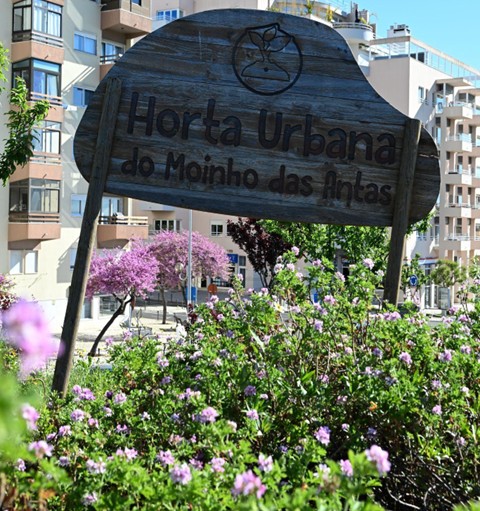
As cities grow wider and green spaces become scarce, urban gardens offer a path to self-sufficiency, while reconnecting the locals with nature and making them a part of food production. Urban gardens also represent a vital stepping stone for fostering community and creating shared spaces, where people can come together, socialise and promote more sustainable ways of living. “The project is very important for people like me, who are already retired, as it’s a great form of exercise and socialization. It’s also amazing being able to plant and bring home our own things”, says Francisco, a 78 year old pensioner, who has been working at the Urban Garden of Moinho das Antas for the last 4 years.
Located on Rua Mateus Fernandes in Paço de Arcos, the Urban Garden of Moinho das Antas has more than 100 gardening spaces, spanning 25 square meters. The urban gardens are a part of the Oeiras municipality’s efforts to balance its economic growth with sustainable and innovative reforms, such as the Echoes of Nature project. The Urban Garden of Moinho also has a teaching area that serves to educate the gardeners and help them manage their gardens. Joining the project can however be quite a lengthy process, as the waiting list spans more than 500 people eager to start gardening. Once you’re accepted, a 60 euro fee must be paid and renewed yearly. They provide a planting calendar, educational booklets, and a manual covering composting, fertilizers and plant types. Gardeners cannot however use any chemicals, plant any trees or bushes or set up any scarecrows.
A refuge from the everyday chaos
For many of those who tend to Oeiras’ urban gardens, the benefits stretch beyond what ends up on their plate. The gardens offer a place to wind down from the chaos of the city and reconnect with nature. Particularly for those navigating retirement, the gardens provide a new kind of daily rhythm. “After you stop working you kind of miss the rush of the day “, says José Paulo, 65 years old, who spent six years on the waiting list before securing his plot. The gardens are also an important part of socialising and fostering community, as the gardeners come together in aid of one another, sharing tips, knowledge, and support to help each other and their gardens thrive. The community aspect and escapism element of gardening in the urban gardens is also the reason why the waiting list is so long, as the community formed around the gardens is the thing that truly attracts new gardeners. “These gardens are an escape mechanism for people, so everyone wants to join.”, adds José.
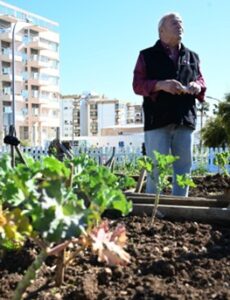
One of the gardeners participating in the project
From soil to plate
Growing your own food is crucial in times where ultra processed foods are taking over households all over the world. Products that are linked to cardiovascular diseases, the increase of anxiety and are loaded with emulsifiers and preservatives, make it harder for many to truly have a healthy lifestyle.”This sort of project is very good for everyone’s well being. Especially because we’re growing our own things.”, says Ana Nunes, 58 years old, who has been working at the gardens for the past year. The urban gardens in Oeiras are therefore key to a healthy community where people can cultivate their own, chemical-free diet.
At the mercy of nature
The project does however face significant challenges. The municipality currently has a total of six gardens distributed across its territory, but are 220 gardeners in a municipality of 170.000 inhabitants truly making a change or is the project only symbolic? There are also unregulated gardens, which the local council is working to integrate into the project by adapting them to meet the required standards, but the process of integration alone can be quite troublesome, as there are a lot of rules the participants have to follow to maintain their participation in the project. Because the rules prohibit the use of chemicals, building protective structures and setting up scarecrows, the gardeners are left at the mercy of nature and its nuisances, such as natural disasters and pests (mice, wild pigeons etc.). These then pose a challenge when it comes to the successful cultivation and growth of new plants. This raises an important question about the symbolic nature of the project in a way. Why should gardeners be restricted in taking measures to protect their gardens? There are many solutions to chemical-free gardening that follow the sustainability standards, such as scarecrows, that help with pests. Could it be because it would impact the visual appeal and the design of the green spaces? The incorporation of protective structures could even serve as motivation for the gardeners.
In José’s words: “the urban gardens of Oeiras are like an oasis surrounded by a desert of buildings.”. They are the gardener’s way to unwind, escape from the suffocating atmosphere of the city and truly focus on their work on their little patch of land. They do however have a few downsides, like the lack of machinery and arbitrary rules, that could possibly demotivate the gardeners. The upsides however overpower the downsides. The gardens are not only good for driving sustainability and balancing economic growth and improving the natural aspects of the area, but also serve the gardeners with improving their mental health and offering a refuge from the city, forming a kind of mutualistic relationship.

You must be logged in to post a comment.