

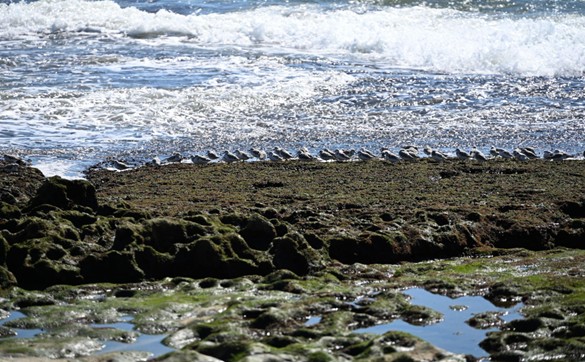
Birds are a quiet but constant presence in our daily life – we wake up with their singing, share the same sky and admire their beauty. Their small actions make our day a little better, but on the other hand us humans sadly do the opposite and are not noticing it. We’ve all seen it: in the movies or on our daily walks – many people are seen giving food to the birds, treating them in the same way we treat ourselves. Even though we all know, for example, dogs cannot eat chocolate because it’s toxic and can affect their health badly, the same level of awareness rarely extends to wild birds.
How do we affect the birds negatively?
One of the clearest examples of how detrimental human behaviour can be to the birds, is feeding them bread. Feeding the birds with bread can often be seen as a fun way to spend time and often even a small act of solidarity towards the birds. The effect is however the opposite. After feeding the birds with bread, it expands in their stomachs and gives them a satisfactory feeling of fullness and gets rid of the need to go search for more food. The problem is however that the bread lacks the nutrition their usual food provides and leads to the so called “angel wings syndrome”, a condition that causes the birds’ feathers to grow at an awkward angle and makes it difficult for them to fly. There is also a bigger, more detrimental consequence to feeding the birds. The more regularly birds are fed by humans, the more they begin to behave like pigeons, losing their natural foraging instincts and becoming dependent on us for their daily meals. Another problem are the invasive bird species currently living in Oeiras, predominantly parrots of afrikan/south-american descent, who are often let out of their homes and left to fend for themselves in the strenuous metropolitan environment. These parrots affect the native bird communication with their loud singing and nesting practice. Parrots often use cavities to form their nests, which then leads to the expulsion of native species, who do the same e.g. woodpeckers. The problem for seabirds specifically can also be fish overconsumption, as less the size of fish colonies directly affects the amount of birds. Who knew that fish caught the “wrong way” (overfishing/bycatch) can have such an impact.
How ignorance and harmful behaviour highlight the importance of education
Sara, a masters student in biology and research, who has also been a participant in the Oeiras’ Echoes of Nature project for many years,believes that behaviour like feeding the birds is very normalised in our society. It’s the same as people riding their bikes without a helmet, clearly knowing it has consequences. Most people are not aware of the impact that they could have on birds, and crucially don’t act harmfully simply out of malice.
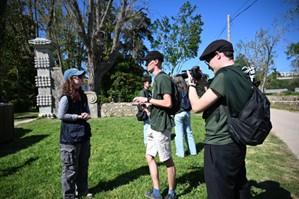
Team Leader Sara Guerreiro in an interview
The members of Oeiras’ Echoes Of Nature project have an uniform solution to the problem of public ignorance and harmful behaviour towards birds: education. “When you know what you’re doing, you can help mitigate the problem”, says Fernando, who has been a part of the project for the last four years. It is often the case, however, that education alone is not enough, especially when trying to educate the older generations, who can be a bit stubborn when trying to change their daily habits. Education is best paired with policy. Portugal has many rules regarding wildlife and environmental protection, but lacks fiscalisation, so there are little to no penalties for wrongdoings. Alexander, a new member in the Echoes Of Nature team and done bachelors in biology, points out that “If a rule isn’t enforced, it isn’t really a rule”. This can also be posed as a cultural problem. People in Portugal aren’t really accustomed to following rules, but that doesn’t mean that they’re doing it out of malicious intent. The educators are often also students eager to gain practical knowledge, as for them the project is just as much about learning as it is about teaching.
The birds will still continue to sing and make our skies a tad fuller, whether we pay attention to them or not. The difference is whether we choose to be conscious of the role we play in their lives. Little things like feeding the birds bread can be seen as a small act of kindness in our world, but actually do more harm than good. The important thing is to spread awareness and educate people. Projects like Oerias’ Echoes Of Nature are proof that awareness is spreading, one stepping stone at a time.

You must be logged in to post a comment.